

Watersgreen House
Click on first cover below for slide show of book covers.

My Ántonia was Cather’s first novel to be considered a masterpiece—an evaluation that still holds true today. Published in 1918, the book established her reputation. Cather continued the focus on place and the emphasis on working-class people that had been ongoing in American literature since the local color movement of the late 1860s, but she brought the focus to a locale—America’s High Plains--that previously had not been explored in such depth.

“I don’t think it’s a stretch to regard The Professor’s House as not only Cather’s best work but as one of the five great novels in American literature.”

Is it dystopian fiction or narrative nonfiction? Daniel Defoe’s A Journal of the Plague Year has baffled publishers and librarians since it’s first appearance in March 1722. It is one man’s account of events during what until recently was the last Great Plague of London in 1665.

By turns funny, romantic, erotic, and sad, this evocative novel brilliantly recreates the landscape of late adolescence, when friendships seem eternal and loves reincarnate. Unique in coming of age fiction, Clicking Beat on the Brink of Nada (Cody) quickly won praise from reviewers and readers worldwide. "Keith Hale's novel aches with adolescent first loves. It is tender, funny, and true." - William Burroughs

Heart and Soul follows Arkansas country boy Ben Goodman through childhood and adolescence, focusing on Ben's life after he crosses paths with the book's other protagonists, the brothers Ethan and Daniel Henry. Each boy has a compelling story, and when the sad stories of their separate lives merge into the tender stories of their time spent together, the result is both heartwarming and hopeful.

What do you do when your girlfriend's younger brother is the best-looking person on the planet and has a thing for you? Parish doesn't know what he's going to do, but he's about to find out. Luke Hartwell delivers a story that is both charming and sexy in this tale of friendship between a younger male who knows he's gay and the guy getting dumped by his sister.

When a young boy at a bowling alley has his cheeseburger delivered by a handsome future air force cadet, an infatuation develops so strong that three years later, when he learns the older boy's home town, he sets off on his bike to find him. The relationship that develops between the two boys is one of the most heart-warming and seductive in coming of age literature.

Keith Hale explores the relationship between gay and straight best friends in this sparse, moving story. Chris has been in love with his best friend Jimmy since childhood. While Chris is at college, Jimmy is sent to prison. Now Jimmy is free once more and the two meet again. Chris, or "Topi," as Jimmy calls him, begins to understand that Jimmy is not the only one who has made mistakes.

Yusuf Parish Jimmy: Two stories from the Heart of Texas and one from the Arkansas Delta collects three of Keith Hale’s shorter works of fiction into one volume. In “Breathless,” a high school senior in small town Arkansas finds a new boy in class on the first day of school--a handsome exchange student from Turkey whose presence in town causes a stir. As the friendship develops, hearts and minds are stirred as well.

Aside from Desire is a complete collection of Luke Hartwell’s shorter fiction as of August 2025. Many of these stories also appear, with commentary from the characters, in Hartwell’s novel Jeremy Bardon. “Handsome Johnny” provides a surprising follow-up to Atom Heart John Beloved. “Huddled Close” is a seductive addition to Love Underneath, while “And Then We Did the Stetson” is an astonishingly sexy postlude to “Michael.” Also sizzling hot are “Huddled Close,” “The Angel,” and “Pillow Talk."

A breathtaking love story and an intense coming of age story that resembles no other book. John's narrative voice is one of the most unique in gay literature. Atom Heart John Beloved is literate, intimate, erotic, and delightful, delivering unexpected moments of grace.

Luke Hartwell does it again! "Baby Self Hate" is a sultry but funny story of sex and infatuation. As always with Hartwell, the brilliance of the narrative voice shines brightest. Cam, like other Hartwell narrators, is angry but funny, purposeful but confused, and humorous but unexpectedly profound. Although sexy and sought after, Cam sees life darkly and takes solace in fishing. His relationship with a boy he meets in therapy is a wild, unpredictable ride.

The general rule with many books involving male-male romance has been that readers who are only interested in the romance have to endure endless subplots and secondary characters that do not interest them or add much to the story in order to get to the good stuff: the intimacy between primary characters. Readers might think that Luke Hartwell’s solution to boring formula novels--giving his protagonist eight love interests--might be overkill. We assure you, it is not.

When college freshman Lucas sees Mason, a senior with stunning good looks, in the nude in a campus production of Equus, he is smitten. But he's also smitten with Juan, the handsome former champion bull rider who accompanied him to the play. To add to the abundance of riches, Juan introduces Lucas to Kaden, the unbelievably attractive eighteen-year-old bull rider he is training who is just beginning a rise that could take him to the top. All eyes are on Lucas, who has eyes for them all.

Jeremy Bardon is an epic tale from Luke Hartwell that, like Atom Heart John Beloved before it, is as profound and beautiful as it is sexually stunning. The characters are as uncommon and breathtaking, not only in appearance but in their worldview, as the Hartwell characters who came before them. Indeed, some of Luke's boys reappear in these pages.

A groundbreaking merger of genres, Luke Hartwell's Love Underneath is as distinctive as its predecessors. Using characters and early chapters from his deleted novel Locomotives in Winter, Hartwell has created a beautiful, sexy story of guys who love.

Ben cannot keep his mind off the handsome young wrestler sitting at the back of his world literature class. He fantasizes and fantasizes, and then he acts.

Luke Hartwell's Nathan's Story combines elements of Keith Hale's coming-of-age novella Space with characters from Luke's provocative novel Atom Heart John Beloved. Hartwell intertwines the story of Nathan and Harper with the story of Nathan and John while avoiding a rehash of the Atom Heart John Beloved story line. The result is a powerful, multi-faceted love story that makes readers think, covers controversial ground, produces tears, and brings plenty of smiles.

Stories contains the two Luke Hartwell short stories that were not incorporated into his expansive novel Jeremy Bardon. In the first story, "Michael," Ben cannot keep his mind off the handsome young wrestler sitting at the back of his world literature class. He fantasizes and fantasizes, and then he acts. The second story, "Baby Self Hate," is a sultry but funny story of sex and infatuation.
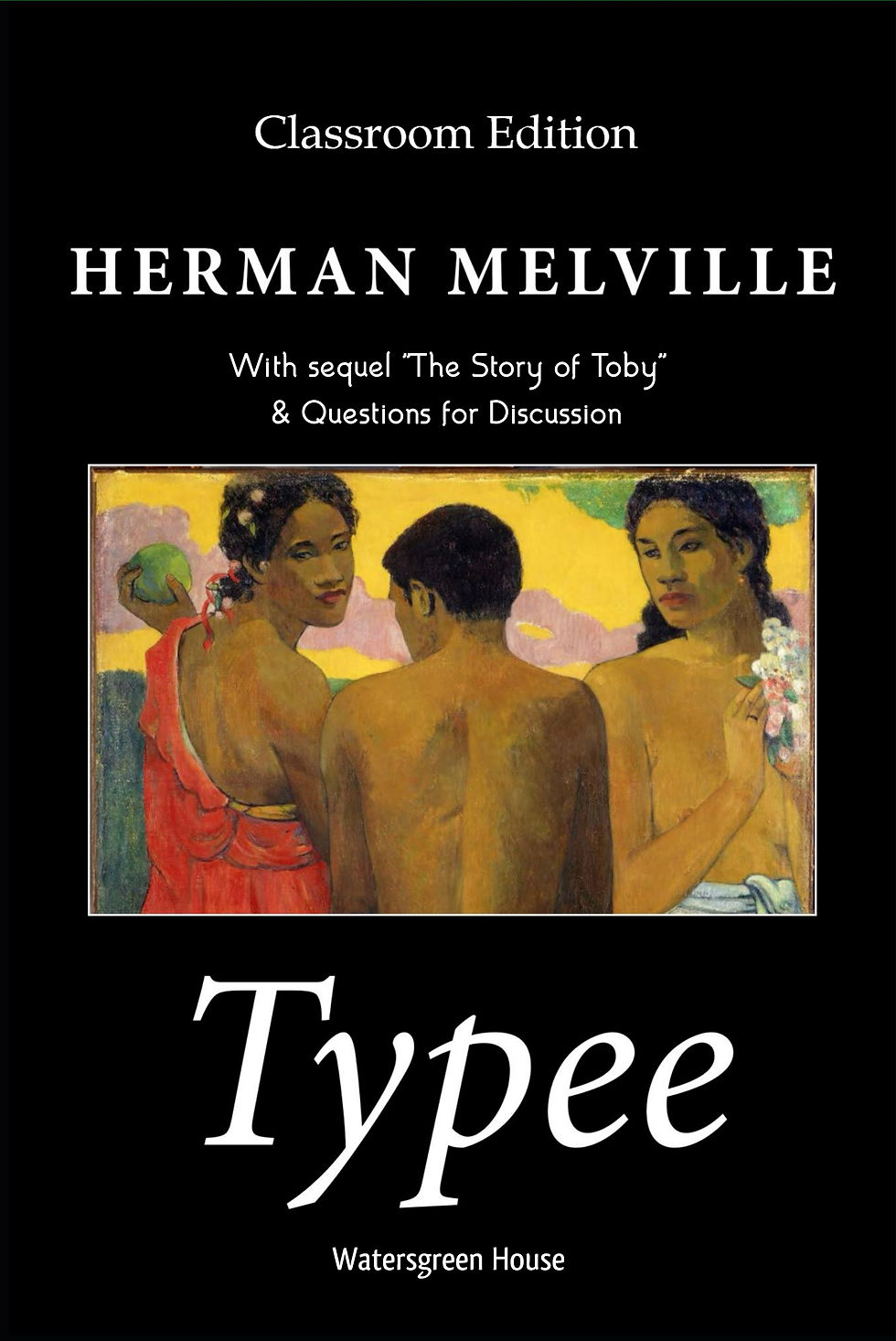
This Classroom Edition of Melville's classic first novel contains questions for discussion to help students with reading comprehension, critical thinking, and a close reading of the text. This edition also contains Melville's sequel to Typee, "The Story of Toby."

"Old St. Paul's … is a 'disaster story' worthy of Hollywood, where an all-star cast is introduced merely to be decimated by fire, flood, earthquake, shipwreck, alien invasion, or act of God. It is an apocalypse of biblical proportions, laced with love, intrigue, bravery, humour and horror."– Stephen Carver

"Plague Ship is a rip-snortingly inventive yarn that's one of [Andrew North's] better novels, a combination of medical mystery, anthropological adventure and space gallop." - Patrick T. Reardon

Now regarded as Mary Shelley's most important novel after Frankenstein, The Last Man portrays an apocalyptic world at the end of the 21st Century ravaged by plague. The dystopian novel not only will appeal to fans of science fiction literature but also fans of Romanticism and its champions, Percy Blythe Shelley and Lord Byron.

Syndrome Johnny features a mind-blowing collection of harrowing short dystopias focused on plagues. The short stories include contemporary fiction such as Charles Dye's "Syndrome Johnny" and Teddy Keller's "The Plague," well-known works like Poe's "The Masque of the Red Death," & also historically-based accounts, including Jens Peter Jacobsen's "The Plague in Bergamo," which details the 12th Century plague that broke out in the city that has been the epicenter of Italy's 2020 COVID-19 epidemic.

A collection of delightful fairy tales and stories of queens from around the world especially chosen to appeal to charming cross-dressers and their devoted friends and fans.

A collection of enchanting fairy tales from around the globe that spur the imagination of boys. Included are classics such as "Jack the Giant Killer," "The Pied Piper," "Tom Thumb," "Ali Baba and the Forty Thieves," and "The Sword of Avalon" along with tales from across the globe that are equally unforgettable.

Favorite traditional fairy tales from folk culture around the globe.